
Oggetto del presente contributo è l’innovazione che concerne i principi generali del diritto amministrativo. Inizialmente questi erano identificati come meri principi generali del diritto amministrativo. Tuttavia, si sta ora attuando un approccio più globale, fondato sui principi dello Stato di diritto, della democrazia e del buon governo, nonché sull’applicazione del diritto costituzionale, europeo e internazionale. I principi generali nel contesto del diritto amministrativo, i principi generali di un’amministrazione efficace e i principi generali della buona amministrazione (buon governo) sono le tre serie di principi che si distinguono in questo contesto. Inoltre, la letteratura olandese sul diritto amministrativo contiene tre nuovi principi: il principio di integrità, il principio di reattività e il principio di uguaglianza (égalité). Recentemente sono emersi inoltre due nuovi principi, per l’inclusione in (progetti) di articoli della legge generale (olandese) sul diritto amministrativo: il principio del supporto adeguato e il principio del servizio.
The subject of this article is the innovation regarding general principles of administrative law. Initially, these were identified merely as judicial general principles in administrative law. However, a more comprehensive approach is now being implemented, which is founded on the principles of the rule of law, democracy, and good governance, as well as the application of constitutional, European, and international law. The general principles in an administrative law context, the general principles of proper administration, and the general principles of good administration (good governance) are the three sets of principles that are distinguished in this context. In addition, the Netherlands administrative law literature contains three novel principles: the principle of integrity, the principle of responsiveness, and the principle of equality (égalité). Very recently, there are two new principles for inclusion in (draft) articles of the (Netherlands) General Administrative Law Act which are discussed here: the appropriate support principle and the principle of servitude.
1. Introductory remarks on General Principles of Administrative Law
There is every reason to be seriously concerned, in the Netherlands but also in other countries, about law and its further development, and in particular administrative law
Important threats arise: on the one hand, degradation of the living environment in the broadest sense of the word, and on the other hand the process of advancing digitization including far-reaching applications of artificial intelligence. The law as well as citizens interacting with public administration must deal with both. The foundations and principles of administrative law are essential for our “legal” future.
This article is a presentation of the central ideas that have been put forward in my 2023 book on general principles of administrative law and their development[1]: from foundations and principles to implementation by the Government, including by the various Government agencies. We will look at legislation, implementation, case law, and advising reports by the fourth power institutions in the Netherlands (chapter 4 of the Dutch Constitution): Council of State, Court of Audit, and the Ombudsman.
I use the term “governance” to refer to the four (public) powers in the State[2]. The administration is only one of these powers, the executive power. When talking about the executive power, there is in the context of general principles of administrative law a distinction between principles of good governance and principles of good administration. This distinction is also relevant in the discussion on the General Principles of Administrative Law as part of the General Legal Principles[3]; this discussion is still ongoing across the different fields of law: public, private, international, and European. I also consider very recent (draft) legislation and case law from the Netherlands supreme administrative court and the ordinary courts.
1.1. Rationale for the book: fundamental, integrated, and wide application
The reason for drafting a book on general principles of administrative law was the need both in theory and in practice for a wide, fundamental, and modern approach to the origin, development, and operation of general principles of good governance at a more integral – about general and specific parts of – administrative law.
The book I refer to[4] can in fact be characterised as the result of a fundamental, integrated, and wide application-oriented research on these principles:
– fundamental: the legal fundaments of a modern State (rule of law, democracy, and good governance);
– integrated: the impact on administrative law from a constitutional, European, and international law perspective, as well as considering ethical and moral aspects;
– wide application-orientated (to activities of all powers in the State): 1. reviewing by the (administrative) court and ombudsman rulings; 2. codifying and harmonizing by the legislator and advisory constitutional bodies; and 3. the instrumental public administration.
1.2. The general principles: beating heart and guidance for tailoring of public administration work
These general principles are the beating heart of administrative law and are the norms for guidance for tailoring the work of the public administration. The principles concern the relationship between citizens and public administration and the relationship between and within distinct parts of the public administration. They are about care and trust, but also about openness and involvement, effectiveness, and accountability. For both administration and citizens, these principles include rights, obligations, and powers in the form of prohibitions and mandatory requirements.
In this context, it is relevant to consider the provision (a general article) included at the beginning of the Dutch Constitution. This was added in 2022 and states: «the Constitution protects the rule of law, democracy, and fundamental rights». This development from an unwritten to a written legal provision has a social and symbolic function and with this eloquent preamble, the Constitution would become not only a more appealing, but also a more inspiring document, as was the idea behind the creation of the provision. Further, this general provision has also acquired a normative function[5]. Therefore, we need a great deal of attention, knowledge, and understanding of the general principles of administrative law, especially in the current era of major social issues: digitisation, computerisation, and public administration scaling up. This is visible in topics that the public administration deals with, such as taxes and benefits, healthcare, social domain, quality of life, housing, climate, and energy supply where in situations there is a need for drastic measures. The distance between citizens and government is great and positions are hardening in all policy areas. From my perspective, the solution to major social problems in the relation between citizens and administration can be found when the government uses available legal principles in an adequate manner. That approach must not be defensive or ignorant of society, but decisive in an open and fair attitude towards the citizens. That is originally and fundamentally the function of the government, guided by which it still fulfils a significant role in the society.
1.3. Third book in a series of three on general principles of administrative law
“General principles of administrative law” is the third book I have written on general principles of administrative law. The first book – “General principles of proper administration” – provided an up-to-date overview of the emergence and development of the general principles of proper administration as principles of review and exceptions by the administrative courts. The book was in 1999 (Kluwer, Deventer)[6] in the administrative law series of monographs on the “Algemene wet bestuursrecht” (General administrative law act, GALA).
In the following period, there was a broadening and deepening of knowledge on and insight into general principles of good governance[7]. Thus, after rule of law/rechtsstaat and democracy, Good Governance became the third cornerstone of the modern state[8]. It is no longer enough to think of the general principles of proper administration as mere traditional developments in general judicial principles. There is a greater need for a broader approach of administrative law principles – in addition to the use of the English names – “good governance” and “good administration”[9].
In the third book[10] – “General Principles of Administrative Law” – I bring together 1. the fundamental concepts (rechtsstaat/democracy/good governance), 2. the principles of administrative law, and 3. the specifications by application in three groups of general principles of universal, proper, and good (including fair) administration/governance together. In this way, we realized a close link between the theory of the general principles of administrative law and the practical effects in the various stages of preparation, development, and implementation of administrative actions and at all stages the corresponding protections for citizens. So, the development of general principles of administrative law does not consist only of general principles developed in the case law, but also includes principles developed by way of regulation and policymaking on good administration (good governance). The concept of the rechtsstaat (rule of law in a broader perspective) is directly linked to good administration (good governance) principles like the principle of properness[11] and the principle of human rights[12]. But also the concept of democracy, which is much more than only a formal management approach of the relation between the administration and citizens, and functions as a source of new principles of good administration (good governance) like the principle of transparency[13] and the principle of participation[14]. Finally, the concept of good governance is not only the third concept – cornerstone – of a modern state but also linked to the two other principles of good governance: the principle of effectiveness[15] and the principle of accountability[16].
Later in this article I will make clear that the links between concepts and principles (as I just described them) are more indicative and certainly not exhaustive.
1.4. Key concerns on administrative law: public administration as quasi legislator
When drafting the book[17], I identified the following key concerns: 1. the professional need for clarification of the foundations, evolution, and coherence in the principles and their application in administrative law and 2. the unrelenting concern for the functioning of public administration in relation to its citizens. The public administration is no longer merely an implementer of the standards set by the legislator but has become more a substitute for the legislator (acting as quasi-legislator), and that has consequences.
In the first place, there is a large gap in legitimacy because Parliament is no longer a co-author of legislation in most matters and can often only afterwards exercise its controlling function and sound the alarm retrospectively when legislation and regulation is (or has been) implemented. Secondly, there is increasing attention in the Netherlands to (administrative) enforcement, where in the past there was often administrative factual non-enforcement (we call it administrative toleration of illegal situations). In the past, administrative authorities would merely ensure compliance, whereas nowadays increasingly they are focusing on sanctions for non-compliance. The public administration can increasingly enforce standards by first focusing on compliance supervision, and later gradually and increasingly by proceeding to actual administrative sanctions. Thirdly, we see that the instruments of administrative action are increasingly on central level taken and less attention is paid to the consequences of these instruments for citizens, resulting in the position of citizens being increasingly at risk. It leads to an abundant number of appeals to the courts, often proving that citizens and public administrations have become each other’s opponents.
In my view, there is too much of an administrative-instrumental approach in administrative law practice and too little of a more principled and citizen-oriented approach. There is a need and necessity for more principle-based (rather than just rule-based) governance action, which requires knowledge and understanding of the content of principles. This makes a restart of conversation between public administration and citizens possible.
1.5. “General Principles of Administrative Law” has three parts and an instructive cover
The book[18] consists of three parts, and the drawing on the cover also paints a picture of the content and interrelationship of three groups of general principles of administrative law. Each of these groups has a hard core, but there is (a double) overlap between them: not only about the three concepts but also related to the principles developed by the concepts. So, there are three partly overlapping circles showing that the principles are partly fluid at the edges and merge into each other; and that principles are on a gradient from concrete to abstract. Furthermore, the principles of proper administration are part of the principles of good administration, but last group of principles has a wider scope. Finally, the universal general principles of administrative law (general principles of law in an administrative law context) are even more abstract and have an even wider scope. These occur in every area of law and therefore also in administrative law.
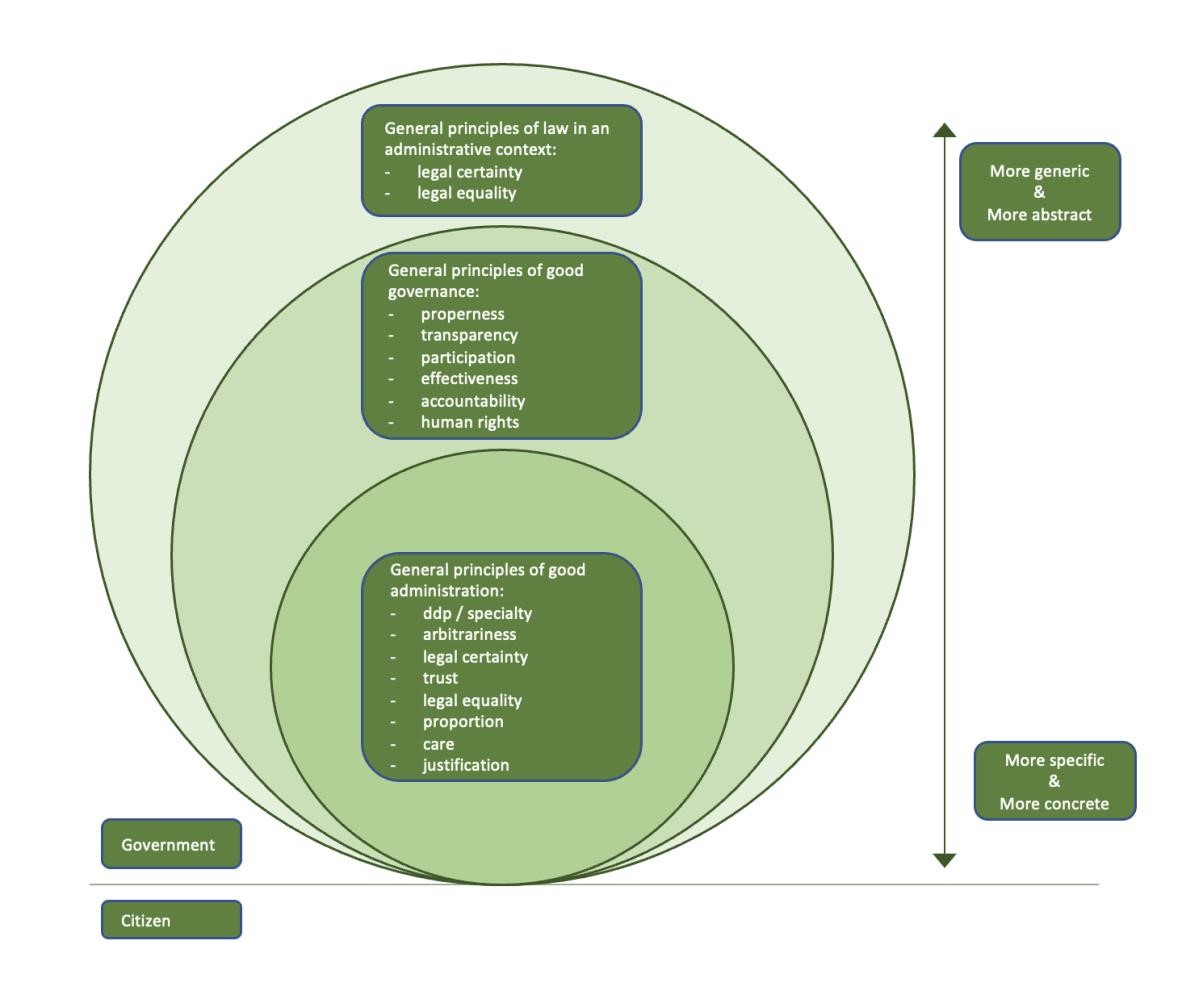
As for the content of the three parts of the book:
Part I presents the foundations, development, and significance in administrative law practice of general principles of administrative law, and the content of the general principles of administrative law in an administrative law context.
Part II contains the origin, creation, and content of eight general principles of proper administration in legislation, case law, and literature and including recent developments in legal practice.
Part III provides the broader scope of Dutch general principles of administrative law and the impact of constitutional law, as well as European and international administrative law, on the general legal principles of administrative law – including administrative morality and ethics, the six general principles of good administration (or broader and related to all the powers in the State: principles good governance).
I will now turn to important themes in each of the three parts.
2. Central themes in part I of the book
In Part I of the book, I discuss three topics related to the development lines of the general principles of administrative law: fundaments, impact, and broader scope and I also make remarks about the first group of principles of administrative law: general principles of law in an administrative law context.
In the first place, concepts of legal theory relating to the legal validity of legal principles and including sources of administrative law principles, are discussed in the book. The legal theory concepts concern the discussions of both natural law and positive law[19], and discussions of the “concepts to interests” approach[20]; in short, the duality in the concept of law.
Secondly, we discuss the increasing impact in administrative law from the point of view of administrative morality and ethics on the one hand, and from constitutional, European, and international law on the other. The first category includes the prominent example of legal aspects of integrity, and the second category includes codification of the democratic rule of law and fundamental rights in the Constitution, international treaties, and the (implementation of) principles codified in the EU Treaties and case law.
I must make two notes here. The first is about the relationship between legal principles and rights. From legal principles flow rights/obligations/powers for the administration and the citizens. In other words, fundamental/constitutional rights and obligations arise from principles for the administration and the citizens. Thus, there is a direct link between principles and fundamental rights, but legal principles encompass more than just fundamental rights (i.e. also duties/powers). The second is related to the pre-processing of international (especially human rights) treaties and European administrative law. In the context of administrative law, I distinguish between the legal terms of “concept” and “principle” – “concept” has for me a more abstract meaning whereas “principle” is more specific in legal terms (or at least less abstract). The use here of the legal term “concept” is partly similar to the understanding of the legal dimension of values which has a broader meaning (and not only legal) as we read it in Article 2 TEU: respect for human dignity, freedom, democracy, equality, the rule of law, respect for human rights.
In the case of EU principles, we can distinguish between principles that determine the (institutional) relationship between the EU and Member States and principles that determine the effect of EU law on national administrative law. But we also find in the EU definition and practice of legal principles, that a legal principle is vague and has a flexible value of “some weight” with the status of legal norm. Comparing this to my definition of legal principle, which means legally significant, there are differences. We also see that fundamental rights are recognised as an EU legal principle already in case law as of 1974 (Nold, No C-4/73), but since codification in Charter (December 2009) these are both recognized in case law and in legislation, giving them a double basis; equality/Title III Fundamental Rights/Art. 30; good administration/Title V Citizens’ Rights/Art. 41; effective legal protection/Title VI Justice/ Art. 47. Legal principles may restrict citizens’ rights: efficiency vs effectiveness, principle of prohibition of abuse of rights. We find a broad interpretation of legal principles in EU law including transparency and effectiveness and a broad interpretation of proportionality. Finally, under EU law, actors within each Member State as well as at EU level (administration and legislator; judge; European Ombudsman) are bound by EU legal principles.
The third topic in Part I of the book is the increasingly broad application of the general principles of law in administrative law context. A distinction is between tasks (functions) in terms of public sector functioning between the reviewing judiciary and the controlling and advisory fourth power institutions (Council of State, Court of Audit and National Ombudsman), the instrumental (de)central and functional administration, and the harmonising and codifying legislator and regulator. It is important for all these institutions to note the position of general principles in the hierarchy of norms in the national legal order in general and more specifically in the general administrative law order. A hierarchy of norms refers to the order of importance in which a norm is within a legal system. These general principles are at the top of the hierarchy together with the legislation and the customary law[21].
2.1. General principles of law in an administrative law context
Finally in part I there is also an explanation about the first group of general principles of administrative law: general principles of law in an administrative law context. This category of general principles of law has a broad and often – but not always – fundamental character and are linked to the essence of a society. These principles are of such significant importance that they give legal normative effect. For example, in Belgium there must always be a specific legal provision in place to support this type of legal principles. However, there are sometimes unwritten and abstract norms and values, here the adage “non scripta lex, sed lata lex” (not written, but born right) applies.
In a sense, these general principles of law in an administrative law context re legal norms at an abstract level and more abstract than the principles of proper administration or the principles of good administration. These principles have a more universal character because you will find them in the general fields of law like constitutional law, criminal law, private law, and international law. Although they are often not (or only partly) formulated within a strict legislative framework, the applicable rules are often sufficiently clear to be the underlying motive for written laws and regulations, for the application by the administration or to play a role in the background when the law is applied by the courts.
The application of certain principles of law may even have the consequence of weakening an effect envisaged by law if the facts and circumstances of a particular case so require. An example from Belgian and Dutch law is the general legal principle of reasonableness and fairness. However, there are also principles that are concrete and enshrined in many EU regulations[22], in international treaties and constitutions, such as the European Convention on Human Rights (and other human rights treaties) and other Council of Europe Good Administration regulations[23] and in the General principles of law (draft) developed by the International Law Commission[24].
General principles of law which are not codified in the law are not (as a rule) enforceable in court in the same way as, for example, an uncontested pecuniary claim. Parties can invoke this in proceedings, in which case it is up to the court to assess whether the given facts and circumstances of the case give reason to apply the legal principle. For example, they make it possible to interpret the general rules of a law in individual cases and, if necessary, to adjust them when that law is incomplete, unclear, or the outcome in the individual case is too harsh. However, substantial unwritten general principles also become more important in practice. The court must identify legislation relevant to these general principles as part of a correct judgment in a specific case and should provide a robust rationale for its decision. Often, the same underlying idea will emerge from different legal texts. That idea will be transformed by its recognition as a general principle of law. An example in Belgium, originating from the Antwerp Court of Cassation, is a case from 2022 where an adult heir successfully invoked the nullity of a testamentary administration clause restricting his property rights. The Court annulled the contested clause on the grounds that the rule of the fundamental legal capacity of everyone is fundamental in the Belgian legal system and exceptions to it can only be made by the legislature. Competent persons of legal age should be able to dispose of their property freely and undisturbed, without accountability for it.
In Belgium and France, a distinction is made between: a. general principles of law with constitutional value, b. general principles of law with legal value, and c. general principles of law of purely supplementary value. The concept of “value” is limited here to “legal value” and within this meaning three values are distinguished. The set of general legal principles embodies the normative unity and consistency in the enormous diversity that characterizes contemporary positive law. The normative unity of law presupposes that the diversity of legal judgments is seen as if it were an elaboration of a set of general principles of law. Legitimate legal formation presupposes respect for these general principles of law. The way in which these general principles are applied may vary. Broadly speaking, a distinction can be made between the principle-compliant explanation and the contra legem application of general principles.
General principles of law have an activating and a protective function. They promote the development of the law: their consideration leads to the formation of legal rules that increase the diversity of the legal system. They thus allow for divergence. At the same time, however, their conservative function is a guarantee of a certain convergence. The competent authorities must justify diversity in the setting of standards. In practice, authorities will have to discover the existence of a general legal principle by inductive means. In that process, unity is found in and thus distilled from the diversity, after which the meaning of a principle can be determined in concrete terms by means of rules based on legal judgments. Principles also form the connecting links between the various areas of law and will have a domain-specific colouring in the context of a field of law. As a context, the specific legal relationship and the interests involved are even more decisive for the meaning that a principle acquires through the process of differentiation. Finally, I argue that an important task of legal scholarship is the “care” of legal principles. It therefore has a special responsibility for the normative – and conceptual – unity and consistency of the law. By exposing the unity of diversity, legal science can contribute to the overview and insight of legislators, judges, administrators, and citizens.
I conclude Part I by distinguishing between the following three groups of general principles of administrative law: 1. general principles of law in an administrative context, 2. general principles of proper administration, and 3. general principles of good administration. But it is not only these three groups as such that are relevant; the relationship between these three groups of general administrative law principles is also important. A broad approach also requires a broad understanding of general administrative legislation, the different institutional contexts, and a broad understanding of the various legal forms in which they manifest themselves.
3. Central themes part II (General principles of proper administration)
The general principles of proper administration originally developed by the judiciary started being applied by both the administrative and other courts in the Netherlands from the 1930s. Proper or propriety means a correct behaviour of the administrative authorities according to rules of moral or polite social behaviour. This meaning has a high social content, which leads to vagueness in practise. Therefore, the judges have refined this over time into separate concrete legal principles. After decades, there was a need for harmonization and codification of these principles in the context of the Netherlands General Administrative Law Act (GALA); this started in the 1990s. Of course, there was not a full codification of all principles and new principles can also be found in the legislation and developed by the legislator.
In the 1999 book “General Principles of Proper Administration” I gave an overview of eight general principles of proper administration developed by the judiciary: “détournement de pouvoir” (abuse of power), unreasonableness, legal certainty, legitimate expectations, equality, proportionality, carefulness, and motivation (justification). In the following overview you will find these principles, the relevant article(s) in the GALA in which these principles have been (partly) codified, and the specification in Dutch case law. Within each of these principles you often find two dimensions (positive/negative, formal/substantial) and more developed further specifications. In part II of the 2023 book “General Principles of Administrative Law” I have further developed the specifications each of these principles in the case law and from the broader perspective of each of the powers of the State, with a special focus on the relevant articles of the Netherlands GALA. These principles of properness are more specific in legal terms than (legal) concepts, but within this group of principles of properness there may also be a gradation in the degree of specification and concretization. In the Netherlands, we distinguish eight principles of proper administration or properness. Within each of the eight principles, a specification by interpretation has taken place in the case law that is (too) briefly indicated in the overview and the relevant article of the law (GALA) is mentioned. This specification can mean in concrete situations that in the case law of the Courts we will discover overlap between principles; in individual cases more principles can be relevant.
I. Prohibition of DDP / Speciality Principle, Gala: Art.3:3:
1. Contrary to purpose, 2. Impure Purpose, 3. Appropriate Use, 4. Use according to purpose.
II. Prohibition of Illegality / Principle of Reasonableness, Gala: Artt. 3:4 and 5:13:
1. Illeness = Manifestly Unreasonable (Utter Systemlessness), 2. Manifestly Unreasonable (Weighing Interests, Not Acceptable), 3. Not Reasonably Arrive t (Marginal Policy Review), 4. Reasonably.
III. Principle of Legal Certainty, Gala: Artt. 4:23 And 5:22:
1. Formal (Knowable Rights and Obligations), 2. Equipment (Durability of Rules; Decision Must Be Complied With; No Infringement Rights Without Law. Basis, Cf. Prohibition Retroactive Effect.
IV. Principle of The Protection of Legitimate Expectations, Gala: Section 4.2.6 On Grants:
1. Generally, Through Policies, Guidelines or Circulars, 2. Concretely Through Individually Generated Trust; Relevant Elements At 1. and 2. Are: A. Who Inspires Trust, B. In What Way, C. What Actions, D. What Factors Oppose Trust.
V. Equality Principle, Gala: Artt. 2:4 and 4:84:
1. Equality Before the Law, 2. Equality in Governance: A. No Bias, B. No Negative Discrimination, C. No Positive Discrimination, 3. Equality in Burden-Sharing in the Public Interest.
VI. Proportionality Principle, Gala: Art. 3:4, Second Paragraph:
1. Administrative Sanctions (Individual and Policy on Sanctions), 2. Other Via Requirement of Correct Ratio Between Means and Ends.
VII. Principle of Carefulness, Gala: Artt. 2:3, 3:2 And 3:4; Sub-Chapter 3.4, 3.6; Sections 4.1.2 And 4.1.3:
1. Material (Careful Balancing Of Interests), 2. Formal (Decision-Making Process), in the Phase of A. Treatment, B. Investigations, C. Hearing and D. Disclosure.
VIII. Principle of Motivation / Justification, Gala: Sub-Chapter 3.7:
1. Material (Valid Justification) In Respect of A. Facts, B. Interests and C. Regulations, 2. Formal (Knowable Justification) Via Notification of Board Motives.
Part II of the General Principles of Administrative Law presents the results of the investigation on developments and nuances of these eight general principles of proper administration in legislation, caselaw and literature, and in particular recent developments in these areas. This list of eight principles is a combination of historical order and substantive distinction. First it discusses more the distinction between substantive and more formal general principles of proper administration. In other countries they are using the names administrative justice or natural justice which have mostly a more procedural meaning in a judicial context. I have chosen in the book[25] a broader – formal and substantial – perspective and including the specification in the administration phase. I have also nuanced all eight principles separately, considering these questions: a. by whom they are developed, b. how they are developed, and c. what these principles are. I have developed these lines based on a similar structure to the book General Principles of Proper Administration (1999), but from a broader perspective, as I explained earlier.
General principles developed in diverse types of legal norms: rights, obligations, or powers. Sometimes these norms have the character of a prohibition (negative) and in other cases function as a requirement (positive). The principle-based norms are relevant in the administrative law (or broader: legal) relationship between administrative institution and citizens or the administrative relations between one and another administrative institution.
Regarding the first two principles (both prohibitive – prohibition of abuse and prohibition of arbitrariness), the literature does not always recognise that these are general principles of proper administration, but the authors in modern textbooks treat both in that context. The prohibition of abuse of power (“détournement de pouvoir”) is a negative norm, with the other (positive) side of the principle being the requirement to act according to the aim of the regulation – also called the principle of speciality. Case law concerns four different administrative standards of conduct in relation to this principle, as mapped out in the book[26]. In the case law we see that the court not only look to abuse by the administration but also abuse by the parties (an example is a case where a person has sent 33 requests for transparency to the administration). The second principle – prohibition of arbitrariness – also has these two sides to it: a prohibition and the requirement to be reasonable. The prohibition of arbitrariness (i.e., manifestly unreasonable balancing of interests) and the requirement of reasonable balancing of interests are closely related: both set a standard for administrative balancing of interests. In the background, the degree of (judicial) review plays a role here: from marginal to more direct, partly under the influence of European and international law. Other powers – public administration and parliament – are sometimes critical of this. Importantly for case law, since 2022 the administrative court has more direct review and is no longer restricted to cases of administrative sanctions.
Then we have two principles which have a close relation to each other: the principle of legal certainty and the principle of legitimate expectations. The principle of legal certainty has a fundamental character and is one of the principles of the rule of law and therefore counted among the (universal) general legal principles in an administrative law context. But it also has a more concrete meaning as a principle of proper administration. We see it in the context of statutory regulations and in the administrative case law (i.e., as a general principle of good administration). The GALA has codified this principle explicitly. It appears from case law that there is often a violation of this principle in situations involving the prohibition of retroactive effect. Therefore, in the literature there is a proposal to codify the principle explicitly in the GALA.
The origin of the principle of the protection of legitimate expectations is in the principle of legal certainty; however, it has now developed its own meaning. The principle aims to: a. maintains citizens’ trust in sustainability of government regulations, and b. uphold the fulfilment of justified expectations, raised by the governing body following elements developed in case law. We see in the case law a more positive use of this principle and in an advice to the administrative court it is suggested to follow three steps in dealing with this principle: firstly, the qualification of the act which created expectations; second, determining whether that commitment can be attributed to the competent administrative body; and third, determining what the significance of the created expectation (or confidence aroused) is for the exercise of the relevant authority.
There are two typical substantive principles, namely the principle of equality and the principle of proportionality. The principle of equality (like the principle of legal certainty) also acts as an abstract general principle of law in an administrative law context, and as a concrete general principle of proper administration. It is one of the fundamental general principles of law, such as is apparent from the place, type, and content of the equality regulations. The equality principle can also have a concrete meaning as a principle of proper administration. In a recent advice to the Netherlands Supreme Court, Advocate-General Snijders makes a distinction between the principle of equality as a general principle of proper administration and the principle of equality as a constitutional right[27]. There are three types of equality: equality before the law, equality in relation to the functioning of the government, and equality in public burden-sharing. At the origin of the proportionality principle there is a connection with the principle of equality (linked to the “égalité” principle). There is, however, a distinction in interpretation between distributive justice (unequal position and distribution in proportion to merit) and retributive justice (equal positions and proportionate adjustments made by unequal transactions).
On both principles there is much to say. Wiarda, one of the founders of the Dutch general principles of administrative law, has qualified the principle of balancing of interests as a general principle of good/proper administration: distinguishing the principle of proportionality as a measure when the public interest must affect the particular interest, and the requirement of balance in relation to a given interest and other comparable cases. The principle of proportionality has been known for much longer in the administrative law of other countries and in European case law, but until recently the principle of proportionality was applied to a limited extent by the administrative court in Dutch administrative law. The latter – the very reluctant use by the administrative judge – is no longer the case (since the Dutch case of the so-called “surcharges affair”/“toeslagenaffaire”), according to the case law. The administrative legislation via the GALA also seems to be adjusted accordingly (see draft proposal for changing the GALA: pre-consultation 18 January 2023), according to a letter from the Minister to the House of Representatives, but has still not been published in the usual way, and that aims to strengthen the guarantee function of the GALA, but does not offer a substantially different, legally based citizen’s perspective. What is striking here is the difference between the first and second part of the draft proposal. The first part is a people-oriented approach (and not a pure legal reason!) that necessitates changes to the Netherlands GALA. The second part concerns the principle of proportionality and presents a legal necessity: a principle-focused approach is explicitly chosen there to give this principle a more explicit place in the GALA. In any case, the principle of proportionality is now recognised in Dutch administrative law, as evidenced by various court decisions (also in connection with the already mentioned “surcharges affair”).
In the same recent preliminary draft, the GALA laid a solid foundation for a principle of proportionality that even outweighs other general principles of proper administration. It seems that the administrative judge in the Netherlands has been hiding behind the facts for too long and has wrongly assumed that they will be playing an administrative role without being sufficiently aware that this is unlawful in the context of the relationship between administration and citizens; more and more government and less and less law. In addition to the arguments of Europeanisation and internationalisation of administrative law, and in the Netherlands also of constitutionalizing of administrative law, it is therefore of significant importance that challenging work must be done to deepen the requirements of rights and obligations as they are necessary in administrative law. One can speak of interweaving law.
Finally, there are two more formal principles: the principle of carefulness (due diligence) and the principle of justification (motivation) – both of which also have substantive elements. The principle of carefulness includes the decision-making process of the public administration: both substantive and procedural. For Wiarda[28] – from a judicial perspective – the fair play principle relies on «openness, honesty, and royalty», while the principle of carefulness (due diligence) is more related to «accuracy and attentiveness and thus the prevention of sloppiness» as well as «the careful balancing of interests: the procedure and the substantive balancing of interests (the formal and the substantive principle of due diligence)». There is a distinction between the positive requirement as a standard for good administration (governance) and the negative prohibition as a standard for judicial review. Within the formal principle of carefulness (due diligence), the following, various sub-aspects of this principle have been developed: careful treatment, careful research, careful hearing, and careful disclosure. Starting in the 1970s, from the due diligence principle, democratic aspects developed about openness, participation, and appeal. These have found a more detailed arrangement in the general administrative legislation. The substantial (material) carefulness principle contains standards about the way interests are weighed, especially where the burdens imposed by the government are concerned. These burdens must be «no more than strictly necessary», «not disproportionately heavy», or «not heavier for one person than for the other». The principle of motivation (justification) requires that the relevant administrative action must be justified. The content of the reasoning followed must be able to support the conclusion (substantive) and the reasoning should be clear (formal). The principle is at issue in the establishment of regulations and their implementation in the context of the review by the administrative law court. The principle of stating reasons originated in the case law and is codified in the GALA and further developed in case law. We see in separate articles of the GALA the requirement of valid motivation or justification (Art. 3:46 GALA) and the requirement of knowable justification (Art. 3:47 GALA). Sometimes actions do not require justification (Art.3:48 GALA); however, the governing body may not simply deviate from advice (Art. 3:49 GALA). The need for a recognizable, sound and supporting motivation[29].
I conclude in Part II that there is nowadays a clear picture of the core of each of the eight principles of proper administration which is broader than only the more procedural principles of administrative justice or the principles of natural justice. The last group of principles are more focused on the judicial process. Nuances show that there is both a distinction and a coherence between those principles and the limits of the judicial interpretation and that sometimes leads to undesirable restrictions for the administration. We see that the administration and the legislator are now developing new principles in regulation and legislation. I will now turn to the important themes of part two of the book.
4. Central themes part II (General principles of proper administration)
In the first part of the book, we have positioned the concept of good governance as the third cornerstone – a fundamental concept – in the phased development of the modern state; good administration is the normative framework for the administration and – as explained – good governance is the (broader) normative framework for all the powers in the State. In the first stage of conceptual development, we see the concept of the rule of law (from the 19th century) and in the second stage the concept of democracy (from the 20th century). The third phase shows a deepening of the concepts of the rule of law and of democracy leading to the new concept of good governance (from the 21st century).
There is a continuous and mutual development – even today – of the three distinguished concepts. These are legal concepts from which the legal principles arise. Principles of good governance can only be legal principles if they are part of the legal system and there is a legal effect in the application of these principles. In a democratic state governed by the rule of law, this takes place at various stages of the legislative and administrative processes.
The elaboration and protection of these general principles of good governance has taken place for a long time at national level in general administrative legislation (as general principles of good administration) and in the framework of human rights regulations at national and international level. I demonstrate this in the book along with the foundations of the rule of law, democracy, and good governance. There is a substantive coherence (correlation) between these three concepts from a constitutional and administrative law perspective in the context of the modern state (and therefore also in the Netherlands) which is expanding partly under the influence of international and European developments. From these three concepts, six general principles of good governance (or more specific general principles of good administration) have emerged: 1. properness, 2. transparency, 3. participation, 4. effectiveness, 5. accountability, and 6. human rights.
The six principles have developed – in line with the literature – in legislation, administrative decisions, case law, and the law related to complaints law and court of auditors’ reports. I will now mention each of the six principles very briefly.
Properness: this has broadened over time through the concept of the rule of law: nuances by the administrative courts, requirements via four core values by the National Ombudsman (1. open and clear; 2. respectful; 3. committed and solution-oriented; 4. honest and reliable) and by the Dutch Data Protection Authority (General Data Protection Regulation).
Transparency: we see this being initiated in the Netherlands by the House of Representatives – and in line with the democracy concept in legislation, this is an extension of public access through a broader interpretation of openness (Open Government Act); I prefer using the word “transparency” because it includes a filter which is sometimes needed in situation of general interest.
Participation: this concerns the active involvement of a group of individuals in a collective process of actual or intended conduct of administrative bodies. The Dutch Minister of the Interior and Kingdom Relations has designed a legal regulation for the participation principle as an elaboration of the concept of democracy at decentralised level. This principle takes different shapes in practice (participation rates): citizens’ initiative, citizens’ panel, referendum, and involvement.
Effectiveness: as in European administrative law, this principle aimed at achieving the objectives of administrative rules and related legal protection along two lines, so effective regulation and effective legal protection citizens.
Accountability: this has evolved from purely financial accounting to public accountability (Court of Audit) and has existed in constitutional and administrative law for much longer (via ministerial responsibility; more generally administrative responsibility as well as responsibility of civil servants).
Human rights: this has developed in addition to the already existing (aspects of) good governance principles in human rights treaties, which thus constitute an important source of good governance. In fact, we find this principle in administrative practice, and the Dutch College of Human Rights is also looking into this. Below is an overview of good governance principles in international human rights treaties[30].
| Treaty | UDHR | ICCPR | ICESCR | ECHR | ESC |
| Carefulness | (13) | 6 (1) | |||
| Legal certainty | 4, 8 (1d, 2) | ||||
| Equality | 1, 2 | 3, 14 (1) | Preamble paras. 2, 2 (2), 3, 7bis | 14 | 20, 27 |
| Participation | 6, 8, 14 (1), 21 (1,2), 29 (1) | 6, 9 (4,5), 13, 16, 25 | 5 (4), 6 (3b-e), 13, EP3 | 15, 22 | |
| Transparency | 8, 40 | 21, 29 | |||
| Accountability | 30 | 1, 5, 40 | 19 | ||
| Effectiveness | 22, 25 (1) | 2, 3, 17 (2), 22 (3), 23 (4) | 5 (2,3), 13, 17 | ||
| General | Preamble par. 2, 2 (3) | 1 (Secures), 2 (1) (Protected
according to the law) |
Part I |
We must be clear that it does not mean that all the elements of these principles are always at stake in every part of government for each activity because their functions are not always the same and the activities can and will differ, legally speaking. These elements do, however, provide a more coherent framework: from these six broader principles to further specifications of each principle.
4.1. Relevant aspects related to general principles of good administration
The general principles of good administration are the result of the effect of the three legal concepts. The three concepts have in the Netherlands a constitutional basis. In this way, the constitutional institutions will flesh out the principles in question. This interpretation may relate to different standards and in different legal forms: rights, obligations, and powers but also requirements and prohibitions in diverse varieties.
These general principles developed along different lines (abstraction, content, scope, and origin) and under the influence of different concepts. Initially, the question was whether the legislature would be able to develop principles. There is now the view that good administration (or broader: good governance) could have prevented an accident such as that of the Dutch case of “surcharges affair”. The general principles of good administration are an important addition to the general principles of proper administration. Of note here is the relationship between the concepts of rule of law, democracy and good governance, and the broadening and deepening of principles.
Indeed, procedures in administrative law contribute to trust, although not always recognise everyone this in terms of law. The government also sometimes makes mistakes. But there is more to administrative law that is important for the pursuit of truth and justice. Those legal norms also go beyond following legally correct procedures. There must be communication, transparency, support, and social cohesion. To make this possible, administrative law offers general principles and other specific requirements that are often bound by policy area.
We can follow the evolution from the Dutch lawyer Van der Heijden’s philosophy of proper administration through Dworkin, Habermas, Raz, and Richardson to the concept of good administration. This approach is in line with the first part of the GALA. But there is currently the question: what about legitimacy in relation to civic trust and social cohesion? A second line is that of the nuances and coherence of these general principles. These nuances are based on the principles of properness (fairness), transparency, participation, effectiveness, accountability, and human rights. There are nowadays three interwoven but distinguished concepts of rule of law, democracy, and good governance. We conclude by identifying three new principles of good governance, which were already visible as sub-principles: the principle of equality, the principle of integrity, and the principle of responsiveness.
5. New Principles of Good Governance: Equality (égalité), Integrity, and Responsiveness
There are in the Dutch literature three new emerging general principles of good governance which I discussed at the end of the book[31]. As indicated at various points in my book[32] there is a smooth transition between general principles of law and the general principles of administrative law: this is equally true for the development of principles of proper administration into principles of good administration. In addition to this connection between these categories of general principles of administrative law, we also see that there is an overlap within these categories and the specifications (nuances) of the general principles. The result of this is that there is a certain degree of subjectivity in the naming and elaboration. This means that specification (referred to here as sub-principles) of the general principles of administrative law can evolve into standalone general principles of administrative law. This applies at least to the following three principles and supplemented by other principles: the principle of equality, the principle of integrity and the principle of responsiveness. They are qualified here as new principles, but these were already mentioned in the discussion of the various sub-principles (see also the overview of the principles of proper administration). Here is a brief overview of the so-called new principles of good governance.
5.1. The development of the principle of equality (“égalité”)
In the Netherlands, there was an extensive dissertation about compensation for loss based on the principle of equality[33]. The principle of “égalité devant les charges publiques” (equality before public charges) is the main legal basis for compensation in the event of lawful government action (compensation for loss). The principle of equality has now gained a firm foothold in administrative law and civil law. “Egalité” is a specification of equality but has found its own content (in a comparable way the principle legitimate expectation has been derived from the principle of legal certainty). We see the principle reflected in Dutch legislation, case law and literature. Questions such as «Does it automatically apply to all forms of lawful government action?», «How is the concept of “disproportionate disadvantage” interpreted?», «What are the civil law criteria from Section 6.1.10 of the Dutch Civil Code (causal link, attribution of benefits, own fault) in disputes about compensation for loss?», «How does the principle of equality relate to Article 3:4, second paragraph of the GALA?».
In addition to national law, Tjepkema has devoted extensive attention to French law, where the principle originally developed. Aspects of liability arising from a legal act under European law are in this context also extensively discussed. In this way, he explores how the principle of equality relates to the right to property under Article 1 of Protocol No 1 to the ECHR. It was also in discussion when compensation for loss may end up in the waters of the prohibited state aid (Art. 107 TFEU) and whether the principle of equality also has significance for the non-contractual liability of the institutions of the European Union (Art. 340 TFEU). In this case, we have chosen to deal with the subject of compensation for loss in the context of the material due diligence principle because of the close connection with Section 3.4(2) of the GALA. This was not only due to the codification of this principle in the context of the general legislation of the GALA, but also because the subject of administrative compensation in Dutch administrative law developed from the practice in the special administrative legislation of what we would nowadays call environmental law. Section 4.5 of the GALA provides for the codification of the principle of equality as a general basis for compensation in the event of lawful government action. In addition to the GALA, the regulation on public compensation is dominated by two important system changes: the bundling and standardisation of environmental law by means of the new Environment and Planning Act and the codification and harmonisation of the law on compensation for loss through the Compensation for Loss and Compensation for Unlawful Decisions Act. The systemic changes in environmental law and the law on compensation for loss are partly interrelated: Chapter 15 of the Netherlands Environment and Planning Act contains a compensation scheme specifically tailored to environmental law, which contains a number of additional rules compared to the general regulation on compensation for loss in Section 4.5 of the GALA.
5.2. The development of the principle of integrity
In a recent speech, I drew attention to the lack of focus on principles in administrative law, both in general and in relation to the principle of integrity in particular. Subsequently, I discussed three key questions related to principles in administrative law:
– Why are legal principles as core elements of administrative law so important, not only for the theory but also for the practice of administrative law?
– What exactly do we mean by legal principles and which administrative law entities give substance to those legal principles in practice?
– Which legal principles can we distinguish in current administrative law and what is the expected development in the coming years?
In the second part of the speech, I addressed the topic “The principle of integrity: a legal principle in administrative law”. I will deal with the following questions more in detail: What is the principle of integrity? Which entities give substance to the integrity principle and in which position/task? And, to which group of general principles do we include the principle of integrity?
The conclusions – too briefly stated here – are as follows. One of the new principles in administrative law is the principle of integrity. It is a legal principle because it has administrative law significance in legislation and jurisprudence. The principle of integrity is related to various general principles of good administration, so one can speak of an administrative law principle of integrity. It is also possible to speak of a general principle of law in an administrative law context.
A legal elaboration of the integrity principle should – from my perspective – be part of Chapter 2 of the GALA, consisting of a list of the elements of the integrity principle, a legal basis for the integrity codes, an elaboration of supervision and the enforcement of the integrity principle. During an expert meeting on a possible legal regulation of integrity (in administrative law), I elaborated on three prominent issues.
Firstly, a distinction must be made regarding the idea of integrity, between subjective (wholeness of individuals in public administration) and objective integrity (core values of public administration). For example, Soeharno drafted his dissertation on the integrity of the judge[34]. Soeharno also published an article on the concept of integrity in which he distinguished between personal and social integrity[35]. My focus is more on the administrative law aspects of integrity which can be distinguished from the ethical and moral dimensions[36].
Secondly, it is particularly important to keep an eye on the context in which a person or an institution conducts themselves depending on their constitutional position. In the context of public administration, this concerns in particular the distinction between administrators (individually or as part of an institution), representatives of the people (individually or as part of a political party), judges (individually or as part of a college), advisers insofar as they belong to the High Councils of State (Council of State, Court of Audit, National Ombudsman) and civil servants working at one of these institutions. Research has shown that this distinction is insufficiently adhered to in integrity investigations by the various research institutes[37].
Thirdly, legislation will have to make a clear distinction between a system which involves the definition of certain skills, qualities and professional values of individuals performing certain functions or professions and a system which lays down certain public standards. At first sight, this second legal form is more difficult because of the (potentially) broad content of the integrity standard, which, because of the different perspectives – ethical, legal, administrative – does not make it easy to arrive at an unambiguous legal description that is also enforceable. As with the development of such standards under administrative law, it makes more sense to indicate those instances where there is a violation of integrity standards – much like the lists of Huberts in combination with the principles of good governance[38]. From my perspective, the GALA would be an appropriate legal framework for this. This does not alter the fact that the parliamentary debate on the Act on the Promotion of Integrity and Functioning of Decentralised Government took place and concluded has by the adoption of the bill by Parliament and the law has been published in the Official Gazette.
5.3. The development of the principle of responsiveness
In the discussion on responsiveness, my former colleague Ten Berge argued in favour of further developing responsiveness as a principle of good governance[39]. For him, this is about the moral norm that a citizen is entitled to dialogue and problem-solving relations with the government. This principle of responsiveness partly has its roots in the citizens’ perspective of the National Ombudsman’s assessment of propriety. For him, administrative morality is the starting point of the word responsive. Scheltema, one of the founding fathers of the GALA, later used the concept of responsive “rechtsstaat” (rule of law) and since then the topics of responsive governance and responsive justice have been discussed by Dutch administrative law authors. From my perspective, it has a broad meaning – like good governance.
The Dutch system of administrative legal protection has traditionally been based on the classical notions of indivisible public interest and vertical public-law relationships. In times of privatisation, individualisation, decentralisation, internationalisation, digitisation and automation, these principles are coming under pressure. There are people who believe that the system is now so alien to reality that it has become untenable in its classical form. In fact, this applies to the whole of administrative law.
The National Ombudsman contributes to the definition of the concept of good administration through their assessment from the perspective of propriety and like the core values further elaborated in this section: open and clear, respectful, committed and solution-oriented, and honest and dependable. These core values are general moral norms, and Ten Berge proposes to replace the principle of propriety as a principle of good governance or to supplement it with responsiveness as a principle of good governance.
It is especially important to have a citizen’s perspective that starts with the preparation of the conduct of the public administration and not only in the context of legal protection, however important that may be. Moreover, it is important to show that rights and obligations for government and citizens also arise from this principle. These include government duties (fundamental rights) and rights (powers), civil rights (human rights) and duties (citizenship). Combined with responsiveness as a principle of good governance, the principles of transparency and participation are equally essential elements for the fruitful development of the democratic dimension of good governance.
6. New Principles of Administrative Law in (draft) Dutch legislation: principle appropriate support and principle of servitude
6.1. The development of the appropriate support principle
Since 1 January 2024, there is a codification of the appropriate support principle in Art. 2:1 of the GALA, by which a new obligation for the administration was introduced, as per Article 2:1, first paragraph: «An administrative body is responsible for providing appropriate support in dealing with that administrative body» (Dutch: Een bestuursorgaan draagt zorg voor passende ondersteuning bij het verkeer met dat bestuursorgaan).
This is an improvement for citizens and added to the GALA via the “Electronic Administrative Traffic Modernization Act” (Stb. 2023, 183). Also, as of 1 January 2024, the heading of Chapter 2 of the GALA will no longer read “Communication between citizens and administrative bodies”, but “Communication with administrative bodies”. According to the explanatory memorandum to the bill submitted in July 2019, the aim of the amendment is to better express the fact that electronic means of communication can be used between administrative bodies (and not only with citizens).
6.2. The development of the servitude principle
There is also a proposal (pre-consultation in July 2024) to insert a new general provision in the GALA (Art. 2:4a) «The administrative body acts subserviently in the performance of its duties». (Dutch: “Het bestuursorgaan stelt zich bij het uitoefenen van zijn taak dienstbaar op”). Service in this context means that government puts the citizen first and works for the citizen. This requires that the administrative body always be aware of the effects of its actions on the citizen and that it organizes policy and implementation in such a way that it serves the interests of the citizen. The recent period has shown that the way in which the government responds to citizens does not always contribute to optimal contact between citizens and administrative bodies. That contact should be improved such that administrative bodies can be addressed in an appropriate manner, not only via a contact form on a website, but also by telephone or by appointment, for example.
The addition of a general provision about servitude in the GALA has significance for the way in which the administration acts in contact with the citizen. The administrative body must provide clear information in a timely manner, for example in a brochure or on a website. One form of service is to send a letter indicating that certain actions are necessary, as often happens when the validity of a passport or driver’s license expires. When seeking contact, an administrative body must consider those it is addressing.
Even if someone contacts an administrative body, said institution must realize that not every citizen knows as much about a subject as the administrative body does. But the administration must also be alert to information about what the citizen wants to achieve with a request, an application, or an objection. An administrative body must use this current information when deciding. The government proposes to record the desired attitude of administrative bodies in the GALA. The administration must observe the principle of servitude in all phases of the performance of its duties. The fact that an administrative institution sometimes must be strict, for example when detecting an alleged violation, does not mean that an administrative body must adopt a different attitude in that case. An administrative body must perform its task but can still be alert to relevant signals from citizens, for example by asking questions.
The proposed Article 2:4a in the GALA has a different objective than the duty of care for the administration as codified in Article 2:1 of the GALA for appropriate support in dealing with that administrative body. The latter duty of care primarily concerns the role of the government in supporting citizens: administrative bodies are responsible for helping in dealing with the relevant administrative body. This duty of care is a concrete expression of the principle of servitude and is for that reason more concrete.
7. Concluding observations
Now we come to the conclusions on general principles of administrative law as explained in the book General Principles of Administrative Law[40]. Development has taken place along different lines (abstraction, content, scope, and context). There have been important additions of general principles of law to the judicial general principles of good administration. These additions are based on the concepts of the rule of law, democracy, and good governance and on the implementation of constitutional, European, and international law in the administrative law context. In part I of the book I have paid broad attention to the topics of fundamental, integration and wide application aspects.
We see three group of principles: the general principles in an administrative law context, the general principles of proper administration and the general principles of good administration. The last group of principles – the general principles of good administration – can also be accessed from a broader governance perspective: the general principles of good governance. I use the term “governance” here for the four (public) powers in the State; administration is only one of these powers, the executive power. From this perspective there is, in the context of general principles of administrative law, a distinction between principles of good governance and principles of good administration. I discuss the first group of general principles of administrative law: the general principles of law in an administrative law context. The principle of equality and principle of legal certainty. This category of general principles of law has a broad and often fundamental character and is part of the fabric of society and is in every field of general law, private, criminal, constitutional and international.
In part II of the book, I discuss the second group of general principles of administrative law: the general principles of proper administration. Originally developed by the (administrative) judiciary but now more codified in the Dutch GALA. We find there the following eight main principles: I. prohibition of ddp/speciality principle (GALA: art. 3:3); II. prohibition of illegality/principle of reasonableness (GALA: artt. 3:4 and 5:13); III. principle of legal certainty (GALA: art. 4:23 and 5:22); IV. principle of the protection of legitimate expectation (GALA: section 4.2.6 on grants); V. equality principle (GALA: art. 2:4 and 4:84); VI. proportionality principle (GALA: art. 3:4-2); VII. principle of carefulness (GALA: artt. 2:3, 3:2 and 3:4; dept. 3.4, 3.6; sections 4.1.2 and 4.1.3); VIII. principle of motivation/justification (GALA: dept. 3.7).
The third group – the general principles of good administration – I covered in part III of the book. These six principles are: 1. properness, 2. transparency, 3. participation, 4. effectiveness, 5. accountability, and 6. human rights. The roots of these principles are not only in Dutch administrative law, but also in Dutch constitutional law and international and EU law. These principles have been developed by different legal entities in the frame of legislation and regulations and in the case law.
In addition to these existing three groups of general principles, we see also three new principles in the Netherlands administrative law literature: the principle of equality (égalité), the principle of integrity and the principle of responsiveness. Very recently, there are two new principles for inclusion in (draft) articles of the GALA: the appropriate support principle and the principle of servitude.
There is a clear connection between the principles and the legal, theoretical, social, and practical developments in the Netherlands. This brings us back to the main elements of the book[41]: it provides a clear view of the foundations of general principles based on legal concepts, the development and implementation of general principles in administrative law, and the various contexts in which this takes place. The practise of the codifying and harmonising legislator, the instrumental administration, and the legal protection of the judge and of the ombudsman, and critical scientists, all look at the standpoints of citizens and government based on law and justice.
- G.H. Addink, Algemene beginselen van bestuursrecht, Wolters Kluwer Deventer, 2023. ↑
- Henk Addink, Good Governance: Concept and Context, Oxford University Press, London, 2019, par. 2.2 Concept of Good Governance, under (a) Governance and administration, pp. 16-18. ↑
- Ibid, Henk Addink, chapter 3 which is about notions, concepts and general legal principles, pp. 65-98. ↑
- G.H. Addink, Algemene beginselen van bestuursrecht cit. in footnote No. 1. ↑
- M. Stremler, “De kernbeginselen van onze Grondwet”: De algemene bepaling in historisch-constitutioneel perspectief, in J.H. Gerards, J. Goossens, E.Y. van Vugt (edited by), Constitutionele verandering in Nederland? De grondwetswijzigingen van 2022-2023, BJU, Den Haag, 2023, pp. 141-174. i.h.b. p. 142); L.C. Groen, De Grondwet waarborgt de grondrechten en de democratische rechtsstaat, in A.W. Heringa, R. Kroeze, K. Yesilkagit (edited by), De Grondwet van 1848 tot nu, BJU, 2023; J. Goossens, M. Kuijvenhoven, De invoering van een algemene bepaling of preambule bij de Nederlandse Grondwet in rechtsvergelijkend perspectief, in Ars Aequi, 2022, pp. 412-419. ↑
- G.H. Addink, Algemene beginselen van behoorlijk bestuur, Kluwer, Deventer, 1999. ↑
- G.H Addink, Goed Bestuur, Kluwer, Deventer, 2010; Henk Addink, Good Governance: Concept and Context, cit; several authors in: A. Buijze, Ph. Langbroek, R. Widdershoven (edited by), Goed Bestuur in perspectief, Kluwer Deventer 2019. Some contributions which are more specific relevant for the topic of this article should be mentioned here: Bas de Gaay Fortman, General principles of law: An essay on meaning and interpretivism, Juli Ponce, Good Governance and New Developments: the Right to Good Administration in the Context of Behavior Law and Economics, Patrick Birkinshaw, General principles of law and the United Kingdom, Raymond Schlössels, The digital (r)evolution of proper administration, Melissa van den Broek, Good administration and effective supervision, Rolf Ortlep, Standing with each other in a legal relationship governed by good faith, Melanie van Zanten and Rob Widdershoven, The proportionality principle and procedural review. ↑
- Henk Addink, Good Governance: Concept and Context, cit., chapter 1. ↑
- Ibid, Henk Addink, chapter 2, par. 2a (Governance and administration), pp. 17-18. ↑
- G.H. Addink, Algemene beginselen van bestuursrecht cit. in footnote No. 1. ↑
- Ibid, Henk Addink, chapter 7, pp. 99-110. ↑
- Ibid, Henk Addink, chapter 1, par. 3, pp. 7-9 (Good Governance and Human Rights) and chapter 12. ↑
- Ibid, Henk Addink, chapter 8, pp. 111-128. ↑
- Ibid, Henk Addink, chapter 9, pp. 129-140. ↑
- Ibid, Henk Addink, chapter 10, pp. 141-156. ↑
- Ibid, Henk Addink, chapter 11, pp. 157-170. ↑
- G.H. Addink, Algemene beginselen van bestuursrecht cit. in footnote No. 1. ↑
- G.H. Addink, Algemene beginselen van bestuursrecht cit. in footnote No. 1. ↑
- In the book I worked out the general discussion on natural law and positive law and how this discussion also influenced the Netherlands discussions on the development of principles of administrative law by Paul Scholten (Asser’s Algemeen deel, Zwolle Tjeenk Willink, 1974) and Henk van Eikema Hommes (Elementaire Grondbegrippen van de rechtswetenschappen, Kluwer, 1972). ↑
- In this discussion I present the interest approach as a further development of the conceptual approach by which the social conflict of interest of citizens gets more attention. J. Petersen, Max Webers Rechtssoziologie und die juristische Methodenlehre, Mohr Siebeck, 2020. See also L. Susskind, J. Cruikshank, Breaking the impasse: consensual approaches to resolve public disputes, Basic Books Inc, New York, 1987. ↑
- See also for the European Union Law: J. Ziller, Hierarchy of Sources and General Principles in European Union Law, in Ulrich Becker, Armin Hatje, Michael Potacs, Nina Wunderlich (edited by),Verfassung und Verwaltung in Europa, Nomos, Baden-Baden, 2014, pp. 334-352. ↑
- Takis Tridimas, The General Principles of EU Law, OUP, Oxford, 1999, 2006, 2016; Hedwig Hofmann, General principles of EU law and EU administrative law, in Steve Peers, Catherine Barnard (edited by), European Union Law, 4th edition, OUP, Oxford, 2023, chapter 8; Katja S. Ziegler, Research Handbook on General Principles in EU Law, Elgar online, 2022; Paul Craig, Grainne de Burca, EU Law. Text, Cases and Materials, 8th edition, OUP, Oxford, 2024. ↑
- U. Stelkens, A. Andrijauskaite (edited by), Good Administration and the Council of Europe. Law, Principles and Effectiveness, OUP, Oxford, 2020. ↑
- Already from 2017 the (UN) International Law Commission worked on the topic “General principles of law” and based on several reports of the Special Rapporteur (Marcelo Varquez-Bermudez) a final draft (A/77/10) has been developed on the transposition of general principles of law, the general principles of law formed within the international legal system, the functions of general principles of law and their relationship with other sources of international law (gap-filling; relationship between general principles of law and other sources of international law; specific functions: – independent basis for rights and obligations, – means to interpret and complement other rules of international law, – ensure the coherence of the international legal system); future programme of work. The draft has been sent by the Secretary-General to Governments for comments and observations by 1 December 2024. ↑
- G.H. Addink, Algemene beginselen van bestuursrecht cit. in footnote No. 1. ↑
- G.H. Addink, ibid. ↑
- AG. Snijders, Conclusion, 24 May 2024, ECLI:PHR:2024:567. ↑
- G.J. Wiarda, Algemene beginselen van behoorlijk bestuur, (VAR-reeks XXIV), H.D. Tjeenk Willink, Haarlem, 1952, p. 5. ↑
- R.M. van Male, Beredeneerd besluiten: plaats, functie en betekenis van het motiveringsbeginsel in het Nederlands bestuursrecht, NTB, 1988, p.73. ↑
- UDHR: Universal Declaration of Human Rights; ICCPR: International Covenant on Civil and Political Rights. ICESCR: International Covenant on Economic, Social and Cultural Rights; ECHR: European Convention on Human Rights; ESC: European Social Charter. ↑
- G.H. Addink, Nieuwe beginselen van goed bestuur: égalité, integriteits en responsiviteit, Kluwer, 2023, chapter 22, par. 22.5, pp. 735-740. ↑
- G.H. Addink, Algemene beginselen van bestuursrecht cit. in footnote No. 1. ↑
- M.K.G. Tjepkema, Compensation for loss based on the principle of equality. A study of national, French, and European law, Kluwer, Deventer, 2010. ↑
- J.E. Soeharno, The Integrity of the Judge. A Philosophical Inquiry, prft. Utrecht University, Ashgate, Aldershot, 2009, Chapter 2: A theory of professional Integrity, pp. 27-24. ↑
- J.E. Soeharno, Aiming for integrity with integrity, in Cambridge Handbook of Compliance, B. van Rooij & A. Sokol (edited by), Cambridge University Press, 2021, pp. 1010-1019. ↑
- G.H. Addink, Concept of Integrity Breakthrough in Law and Social Science: Fundamental Legal Remarks, in G. de Graaf, It is all about integrity, stupid (edited by), Eleven Intl Pub, 2019. ↑
- G.H. Addink, The assessment of integrity violations assessed; an investigation into the administrative-legal assessment framework for investigations into integrity violations in the public sector; preliminary advisory report constitutional law conference 2013. ↑
- L.W.J.C. Huberts, The Integrity of Governance. What is, What We Know, What is Done and Where to Go?, Palgrave Macmillan, 2014. ↑
- J.B.J.M. ten Berge, Responsiviteit als beginsel van goed bestuur, in A. Buijze, Ph. Langbroek, R. Widdershoven (edited by), Goed Bestuur in perspectief, cit., pp. 59-66; M. Scheltema, Bureaucratische rechtsstaat of responsieve rechtsstaat? In NTB, 37(9), 2015, pp. 287-289; M. Scheltema, De responsieve rechtsstaat: het burgerperspectief, in NTB, 24(6), 2019, pp. 246-253. ↑
- G.H. Addink, Algemene beginselen van bestuursrecht cit. in footnote No. 1. ↑
- G.H. Addink, Algemene beginselen van bestuursrecht cit. in footnote No. 1. ↑
