
Il contributo analizza le sfide connesse alla garanzia dell’accesso a un’abitazione adeguata per gli sfollati interni in Ucraina e valuta il potenziale dell’intelligenza artificiale (IA) nel migliorare l’assegnazione degli alloggi e il funzionamento dei registri degli sfollati interni. Il fenomeno dello sfollamento interno su larga scala, iniziato nel 2014 e intensificatosi a seguito dell’invasione su vasta scala del 2022, ha messo in luce la frammentazione dei registri statali, l’assenza di un coordinamento digitale unitario e la limitata capacità istituzionale di soddisfare il fabbisogno abitativo. Sulla base di richieste di accesso alle informazioni presentate alle autorità centrali e regionali, lo studio individua significative lacune nei programmi abitativi esistenti, l’assenza di una risorsa nazionale centralizzata e incoerenze nelle prassi amministrative.
L’articolo sostiene che l’integrazione dell’IA nel nuovo Sistema informativo e analitico dei beni immobili potrebbe migliorare l’accuratezza dei dati, automatizzare le verifiche, individuare frodi, supportare analisi predittive e migliorare i processi decisionali. Gli strumenti basati sull’IA potrebbero inoltre semplificare l’interazione con gli utenti, accelerare l’esame delle domande e ridurre i ritardi burocratici. Al contempo, lo studio evidenzia i rischi giuridici ed etici connessi alla protezione dei dati, alla trasparenza e ai bias algoritmici, sottolineando la necessità di armonizzare la legislazione ucraina con l’AI Act dell’Unione europea e con il GDPR.
This article analyses the challenges of ensuring access to adequate housing for internally displaced persons (IDPs) in Ukraine and evaluates the potential of artificial intelligence (AI) to improve housing allocation and the functioning of IDP registries. Large-scale internal displacement since 2014, intensified after the 2022 full-scale invasion, has exposed fragmentation in state registries, a lack of unified digital coordination, and limited institutional capacity to meet housing needs. Based on information requests submitted to central and regional authorities, the study identifies significant gaps in existing housing programmes, the absence of a centralised national resource, and inconsistencies in administrative practices. The article argues that integrating AI into the newly established Information and Analytical System of Real Estate Assets could enhance data accuracy, automate verification, detect fraud, support predictive analytics, and improve decision-making. AI-based tools may also simplify user interaction, accelerate application processing, and reduce bureaucratic delays. At the same time, the study highlights legal and ethical risks related to data protection, transparency, and algorithmic bias, emphasising the need to harmonise Ukrainian legislation with the EU AI Act and GDPR.
1. Introduction
The large-scale internal displacement in Ukraine, significantly intensified since 2014 and further escalated following the full-scale invasion in 2022, has created a persistent and complex challenge in ensuring access to adequate housing for IDPs[1].
The number of IDPs in Ukraine has changed significantly from 2014 to 2024. While the figure remained around 1.5 million in 2021, in 2022, more than 7.5 million IDPs were officially registered. This large-scale increase has significantly affected the state’s ability to ensure these citizens’ constitutional rights, in turn affecting the level of social protection available to them.
The analysis begins with a brief overview of macro-level indicators that demonstrate the scale, significance, and ongoing relevance of the issue under consideration. This dynamic is clearly reflected in the changing number of IDPs, as illustrated in the diagram below[2].
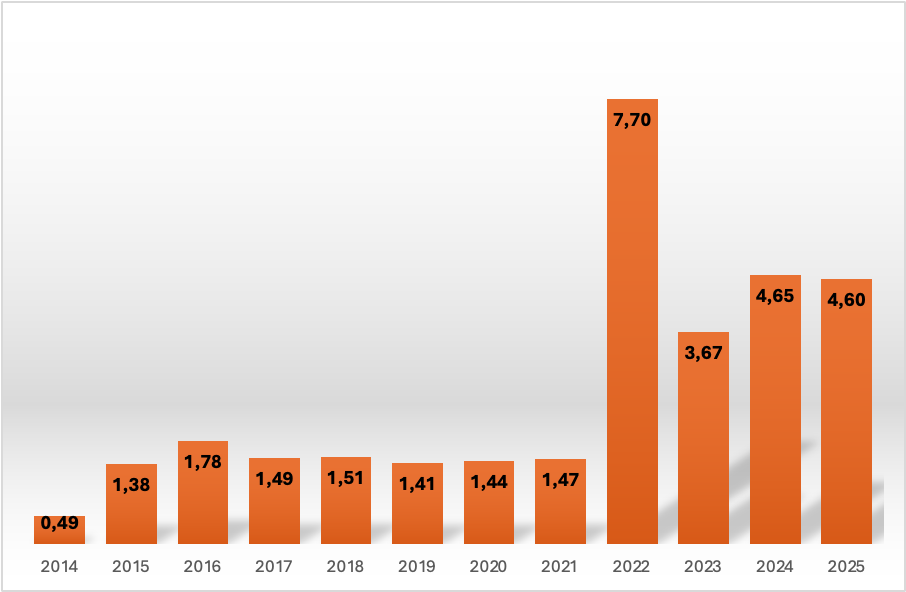
Figure 1
In addition to the overall number of IDPs, it is also necessary to consider their uneven territorial distribution across the country, including differences by type of settlement. In particular, the chart «Share of IDPs by Type of Settlement» presented below clearly illustrates the concentration of displaced persons in large urban areas. This pattern, in turn, may lead to localised pressures on the housing market, the labour market, and other public sectors.

Figure 2[3]
One of the key obstacles in this context is the fragmentation and inefficiency of state registries and administrative procedures related to housing provision for IDPs. Dispersed databases, limited interoperability between public authorities, and a lack of unified digital infrastructure hinder timely and transparent decision-making. As a result, many IDPs continue to face difficulties in accessing reliable information about available housing programs and in effectively exercising their constitutional right to housing.
In response to these challenges, increasing attention has been given to the potential use of AI and data-driven technologies in public administration. AI-based tools may significantly improve the management of IDP-related data by enhancing data accuracy, enabling predictive analytics, reducing administrative burdens, and supporting more efficient allocation of housing resources. However, the integration of AI into such sensitive domains raises important legal and ethical concerns, particularly regarding data protection, transparency, accountability, and the prevention of algorithmic bias.
At the same time, the legal framework governing the use of AI in Ukraine remains fragmented and underdeveloped. While certain aspects are regulated through legislation on digital transformation, personal data protection, and electronic governance, Ukraine has not yet adopted a comprehensive legal act addressing the development and use of AI systems. In this regard, the European Union’s Artificial Intelligence Act (AI Act) represents a relevant reference model for shaping national regulatory approaches.
The purpose of this study is to comprehensively assess access to adequate housing for IDPs in Ukraine and to analyze the realization of their constitutional right to housing under martial law, as well as to substantiate the feasibility of integrating AI into existing state registers in order to enhance the effectiveness of implementing this constitutional right, optimize the work of public officials, minimize excessive bureaucratic procedures, and accelerate the provision of public services for IDPs. In addition, the study emphasises the need to establish a National Register of State, International, and Local Housing Credit Support Programs for IDPs (the Unified State Register of Preferential Credit Programs for IDPs) and to integrate AI tools into this register.
This study involved the systematic collection of information from all relevant public authorities at both the regional and national levels through the submission of formal information requests. The data obtained are subsequently used as primary empirical material, enabling the authors to reconstruct the current de facto governance model in matters related to the redistribution of resources aimed at safeguarding the rights and freedoms of IDPs. This approach also allows for the identification of structural shortcomings, gaps in the coherence of institutional practices, and key areas for improving governance processes.
2. Constitutional and legal framework of housing rights of IDPs
According to Article 47, 48 of the Constitution of Ukraine, everyone shall have the right to housing. The State shall create conditions enabling every citizen to build, purchase, or rent housing. Citizens in need of social protection shall be provided with housing by the government authorities and local government, free of charge or at a price affordable for them in accordance with law. No one shall be forcibly deprived of housing other than based on the law pursuant to a court’s decision. Everyone shall have the right to a standard of living sufficient for themselves and their families including adequate nutrition, clothing, and housing[4].
In addition to the Constitution of Ukraine, the housing rights of IDPs are regulated by the Law of Ukraine «On Ensuring the Rights and Freedoms of Internally Displaced Persons», as well as by a number of subordinate regulatory acts, including: «Certain Measures for the Formation of Housing Funds Intended for the Temporary Accommodation of Internally Displaced Persons» (Resolution of the Cabinet of Ministers of Ukraine of April 29, 2022, No. 495); «On Approval of the Procedure for the Inspection of Real Estate Objects for Housing Internally Displaced Persons and the Standard Form of the Real Estate Inspection Act» (Resolution of the Cabinet of Ministers of Ukraine of April 29, 2025, No. 489); «Certain Issues of Organizing the Inspection of Real Estate Objects for Housing Internally Displaced Persons » (Resolution of the Cabinet of Ministers of Ukraine of April 29, 2025, No. 493); «Certain Issues Concerning the Establishment and Functioning of the Information and Analytical System of Real Estate Assets for Ensuring Housing for Internally Displaced Persons and Its Interaction with Other Information and Communication Systems» (Resolution of the Cabinet of Ministers of Ukraine of July 16, 2025, No. 894), as well as other regulatory acts.
According to Article 41 of the Law of Ukraine «On Ensuring the Rights and Freedoms of Internally Displaced Persons», the Unified Information Database on Internally Displaced Persons is established for the purpose of registering such persons. The central executive authority responsible for the formulation and implementation of state policy in the areas of social protection, social services for the population, volunteer activity, family and children’s affairs, children’s health improvement and recreation, as well as the protection of the rights of persons deported on the basis of nationality who have returned to Ukraine, is entrusted with ensuring the establishment and maintenance of the Unified Information Database on Internally Displaced Persons[5].
The Unified Information Database on IDPs is owned by the State, represented by the Ministry of Social Policy of Ukraine, which also holds the exclusive proprietary intellectual property rights to its software. The database contains information on the housing and other essential needs of IDPs and the level of their satisfaction.
For assessing housing needs, relevant data from the database may be provided to the Ministry for Communities and Territories Development of Ukraine upon request. Accordingly, the Ministry of Social Policy serves as the central executive authority possessing up-to-date information on the housing needs of IDPs.
Pursuant to the Resolution of the Cabinet of Ministers of Ukraine of 21 July 2025 on the optimization of central executive authorities, the Ministry of Social Policy was reorganized into the Ministry of Social Policy, Family and Unity of Ukraine, which became the legal successor to the rights and obligations of the Ministry of National Unity. Consequently, the Ministry of Social Policy, Family and Unity of Ukraine is currently the central executive authority responsible for ensuring the rights of IDPs.
3. Gaps of the existing housing support system for IDPs
In order to examine the state of housing provision for IDPs in Ukraine, the authors submitted information requests to the Ministry of Social Policy of Ukraine, the Ministry of National Unity of Ukraine, the Ministry for Communities and Territories Development of Ukraine, the Ministry of Finance of Ukraine, the State Specialized Financial Institution «State Fund for Youth Housing Construction Assistance», and all Regional State Administrations regarding the following issues: housing programs for IDPs that were implemented or remain in force in Ukraine during the period from 24 February 2022 to 15 July 2025; the number of IDPs registered nationwide as persons in need of housing or improvement of housing conditions during the period from 24 February 2022 to 15 July 2025, broken down by year and by region; where information on available housing programs for IDPs in Ukraine is published; whether there is a centralized online resource in Ukraine (website, register, etc.) that contains comprehensive information on all housing programs available to IDPs nationwide, including those involving credit financing, and, if so, a request to provide a link to such a resource.
However, in its letter dated 24 July 2025 No. 420/0/98-25/314, the Ministry of Social Policy of Ukraine stated that it does not possess the requested information and forwarded the authors’ inquiry to the Ministry for Communities and Territories Development of Ukraine.
The Ministry of National Unity (which until 3 December 2024 operated under the name Ministry for Reintegration of the Temporarily Occupied Territories of Ukraine), in its letter dated 22 July 2025 No. 22/4.1-2639-25, reported that, according to the information available, during the period from 2021 to 2024 the Ministry for Reintegration of the Temporarily Occupied Territories of Ukraine, together with its partners, implemented international technical assistance projects (hereinafter referred to as ITA projects), namely: «Support to the Development of Social Infrastructure (UFSI VI)», «Support to the Development of Social Infrastructure (UFSI VIII)», «Support to the Development of Social Infrastructure (UFSI IX)», «Improving Housing Conditions for Internally Displaced Persons in Eastern Ukraine», and «Housing Premises for Internally Displaced Persons». The Ministry for Community Development provided the following information, as summarised below:
Table 1
| № | Program Name | Responsible Executor | Program Implementation Period | Allocated Funds for Program Implementation | Funding Sources (state/local/budget/etc.) | Number of IDP Families Receiving Funds per Year | Number of IDP Families Provided with Housing per Year |
| 1 | «Provision of Preferential Mortgage Loans to IDPs» (CMU Resolution No. 451 of 28/04/2021) | SSFU «State Youth Housing» | 2021–2028 | For 2025 – UAH 215.67 million from the state budget | State budget, KfW reconstruction grant | 2021 – 241 families2022 – 332 families2023 – 94 families2024 – 322 families2025 – 64 families | 2021 – 241 families2022 – 332 families2023 – 94 families2024 – 322 families2025 – 64 families |
| 2 | Provision of Preferential Mortgage Loans to IDPs using loans from the Council of Europe Development Bank | SSFU «State Youth Housing» | Grant agreement of 2025 between Ukraine and CEB | Planned funding 2026–2028 | State budget, grant funds from the Council of Europe Development Bank | – | – |
| 3 | Budget program for providing long-term preferential loans to IDPs, ATO participants and/or Joint Forces Operation participants for housing (CMU Resolution No. 980 of 17/11/2019) | SSFU «State Youth Housing» | 2019–2028 | For 2025 – UAH 22.00 million from the state budget | State budget | 2022 – 7 families2023 – 6 families2024 – 9 families2025 – 3 families | 2022 – 7 families2023 – 6 families2024 – 9 families2025 – 3 families |
| 4 | State preferential lending to individual rural developers for construction (reconstruction) and purchase of housing (CMU Resolution No. 1547 of 05/10/1998) | Regional Support Funds | Accounting of citizens with IDP status has been conducted since 2022; funding planned until 2028 | For 2025 – UAH 31.56 million from the state budget | State budget | 2022 – 37 families2023 – 54 families2024 – 21 families | 2022 – 37 families2023 – 54 families2024 – 21 families |
This information pertains exclusively to housing acquisition or mortgage lending. Furthermore, in the aforementioned response, the Ministry of Communities and Territories Development of Ukraine recommended seeking more detailed information from the State Specialized Financial Institution «State Fund for Youth Housing Assistance SSFU» «State Youth Housing» (hereinafter referred to as the Fund), which is indicated as the responsible executor of the housing provision programs for IDPs listed in the table. However, in its response to authors dated 21 July 2025, No. 1436/005, the Fund stated that it does not possess information regarding any such programs, including where the information is located or who holds it.
Consequently, the organization designated as responsible for the implementation of state programs, to which the Ministry refers, does not have any information regarding the existence of such programs. As a result, internally displaced persons who approach this institution to obtain information about the programs in which they may participate do not receive such information. This situation constitutes a violation not only of their constitutional right to access information but also of their right to housing, leading to a failure of the State to fulfill its obligations toward individuals and to guarantee the protection of human rights.
Additionally, the Ministry of Communities and Territories Development of Ukraine provided a response stating that there is no single centralised online resource containing information on all housing programs available to IDPs across the country.
Regarding the number of IDPs registered nationwide as requiring housing or improvements to their living conditions for the period from 24 February 2022 to 15 July 2025, the Ministry provided the information presented below.
Table 2
| № | Administrative-Territorial Unit | Social Housing Register / Temporary Housing Fund Register | |||
| 2022 | 2023 | 2024 | 2025
(І half) |
||
| 1 | Vinnytska | 67/137 | 129/353 | 129/353 | 214/548 |
| 2 | Volynska | 37/24 | 97/230 | 114/391 | 113/471 |
| 3 | Dnipropetrovska | 203/586 | 204/752 | 204/752 | 130/485 |
| 4 | Donetska | 29/622 | 41/789 | 44/792 | 43/774 |
| 5 | Zhytomyrska | 8/104 | 35/223 | 51/1402 | 54/1455 |
| 6 | Zakarpatska | 3/703 | 3/267 | 3/267 | 3/267 |
| 7 | Zaporizka | 1/39 | 0/39 | 0/103 | 8/119 |
| 8 | Ivano-Frankivska | 32/76 | 35/57 | 33/708 | 71/905 |
| 9 | Kyivska | 0/0 | 0/0 | 211/773 | 211/773 |
| 10 | Kirovohradska | 0/0 | 0/715 | 0/1007 | 0/2459 |
| 11 | Luhanska | 0/0 | 0/0 | 0/0 | 0/0 |
| 12 | Lvivska | 0/430 | 0/510 | 0/743 | 0/1581 |
| 13 | Mykolaivska | 5/35 | 0/112 | 0/112 | 0/112 |
| 14 | Odeska | 5/109 | 5/356 | 10/373 | 7/0 |
| 15 | Poltavska | 32/300 | 816/817 | 38/1028 | 38/1180 |
| 16 | Rivnenska | 0/477 | 0/704 | 5/704 | 1/1796 |
| 17 | Sumska | 43/69 | 2/114 | 3/196 | 3/335 |
| 18 | Ternopilska | 2/14 | 10/390 | 12/1247 | 13/1423 |
| 19 | Kharkivska | 46/112 | 71/165 | 57/1906 | 114/446 |
| 20 | Khersonska | 0/0 | 5/36 | 5/384 | 5/384 |
| 21 | Khmelnytska | 23/374 | 23/378 | 23/1169 | 23/1176 |
| 22 | Cherkaska | 30/144 | 30/226 | 48/454 | 52/1076 |
| 23 | Chernivetska | 0/0 | 0/982 | 0/2272 | 0/2662 |
| 24 | Chernihivska | 2/404 | 0/571 | 7/333 | 4/327 |
| 25 | Kyiv City | 38/1418 | 76/1346 | 131/2657 | 54/3069 |
| 606/6177 (186 families provided with social housing / 2472 IDP families provided with temporary housing) | 1582/10132 (352 families provided with social housing / 2868 IDP families provided with temporary housing) | 1128/20126 (399 families provided with social housing / 3950 IDP families provided with temporary housing) | 1161/23814 (434 families provided with social housing / 4205 IDP families provided with temporary housing) | ||
A comparative analysis of the number of IDPs over the years (Figure 1) and the Ministry’s data on the total number of IDPs nationwide (Table 2) who need housing demonstrates that IDPs are largely compelled to address their housing needs independently, primarily by renting accommodations at their own expense. This observation is further corroborated by the data in Figure 3 bellow.
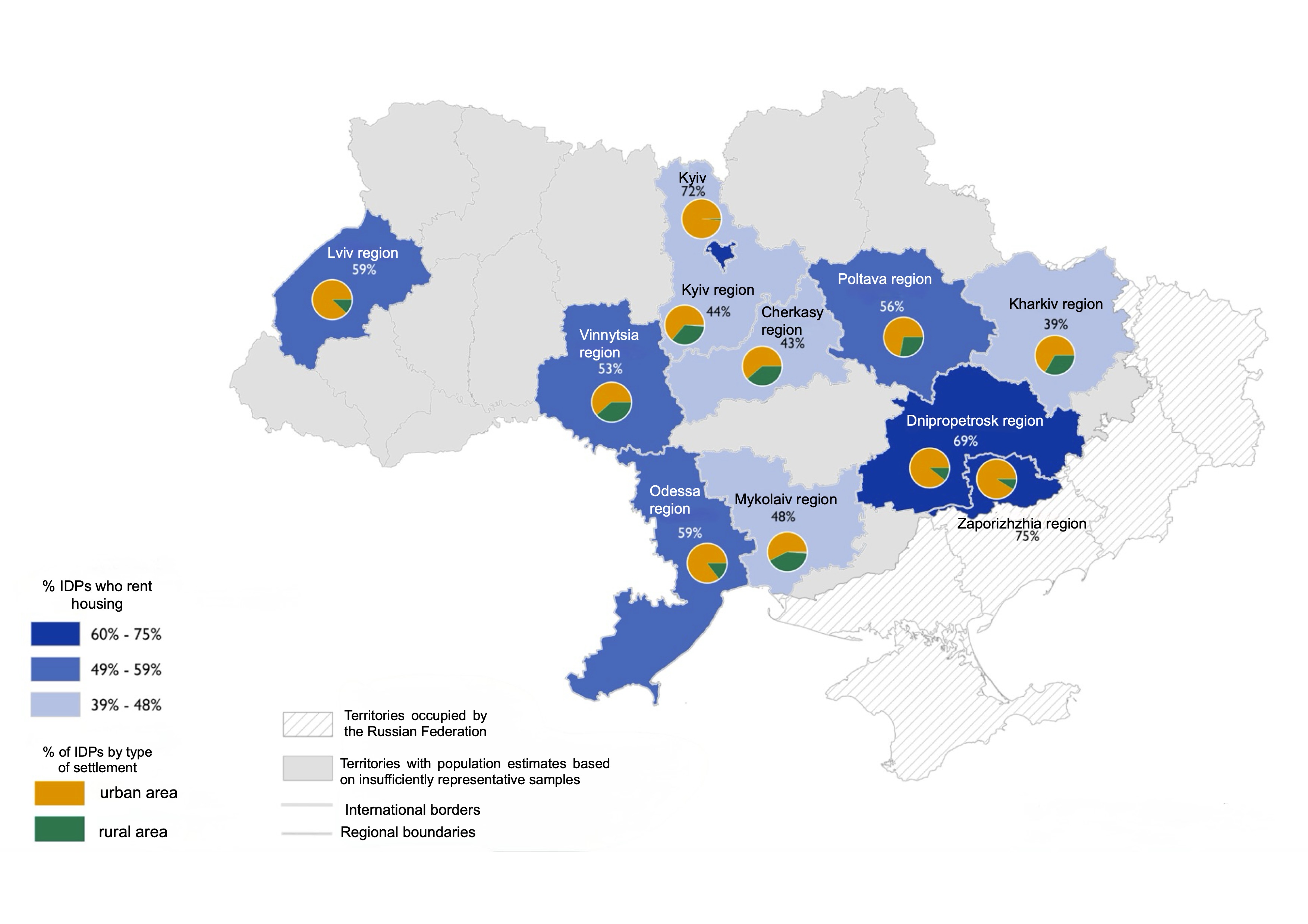
Figure 3[6]
In 2021, Isayeva N. proposed the creation and management of a Unified State Register of state, communal, and private real estate that could be made available for IDPs, including the introduction of relevant amendments to the Law of Ukraine «On Ensuring the Rights and Freedoms of Internally Displaced Persons»[7]. In November 2024, the relevant amendments were adopted, and an Information and Analytical System of Real Estate Objects was introduced to provide housing for internally displaced persons[8]. On July 16, 2025, by Resolution No. 894 of the Cabinet of Ministers of Ukraine, the Procedure for the Functioning of the Information and Analytical System of Real Estate Objects for Providing Housing to Internally Displaced Persons and Its Interaction with Other Information and Communication Systems (hereinafter – the Information and Analytical System, IAS) was approved[9].
The Resolution also establishes the procedure for the development and implementation of the Information and Analytical System, ensuring access for IDPs and integration with other state registers. Since this IAS is currently being established, the Verkhovna Rada of Ukraine and the Cabinet of Ministers of Ukraine have time to legislatively approve and implement AI tools within the system.
4. AI as a tool for improving housing allocation and IDP registries.
The legal basis for the provision of electronic administrative services in Ukraine is established by the Law of Ukraine «On Administrative Services», which provides for the functioning of the Unified State Web Portal of Electronic Services as the official source of information on administrative services in Ukraine[10]. In addition, the Concept for the Development of Digital Competencies, approved by the Cabinet of Ministers of Ukraine, forms part of the broader national strategy for digital transformation and the integration of modern technologies into public administration[11].
Despite progress in digital governance, the current system of IDP registration and housing support remains fragmented and administratively burdensome. Traditional information systems have proven insufficiently flexible to process rapidly changing data on displacement, housing needs, and social support. In particular, the lack of unified digital coordination among state institutions complicates the effective allocation of housing resources and slows decision-making processes.
In this context, AI technologies may become an effective tool for improving housing governance and the functioning of IDP registries. AI systems based on machine learning, natural language processing, and intelligent data analysis can significantly improve the processing of large volumes of information and support evidence-based administrative decision-making.
Therefore, while the IAS is still in the stage of development and integration with other state registers, it is necessary to develop appropriate procedures and define algorithms for processing information, including confidential data, as well as for protecting the personal data of individuals whose information will be included in the IAS.
The authors believe that integrating AI into the IAS will simplify the work of the responsible commissions, as it will allow:
- rapid verification and updating of IDP data;
- detection of duplicate applications and prevention of fraud;
- forecasting housing and social support needs;
- optimisation of housing allocation procedures;
- analytical support for state authorities responsible for resource distribution.
- automatic assessment of the technical condition of real estate objects (based on photos/videos);
- intelligent classification of housing by parameters (suitability, location, energy efficiency) with forecasting of financial needs and potential resources for housing stock renovation;
- automatic generation of reports, text recognition, and digitisation of information;
- obtaining recommendation algorithms for housing allocation.
For IDPs, the use of AI will significantly simplify interaction with the IAS, as it would enable: the implementation of a chatbot for user interaction and application submission; intelligent housing selection taking into account family size, age, health condition, place of work or study, and accessibility of infrastructure; faster data processing and minimization of the time between application submission and receiving a decision; and elimination of the human factor in considering all parameters necessary for making a well-founded decision. Furthermore, a centralised, uniform approach with real-time data synchronisation could enable the redistribution of workload across the country based on available resources and facilitate evidence-based analysis to help individuals choose a specific settlement before relocation. This could also accelerate the resolution of the sensitive issue of individuals refusing to leave dangerous areas due to uncertainty and fear of the unknown. Awareness that housing is available, coupled with access to detailed information and real photos, can significantly speed up the decision to leave conflict zones, thereby reducing civilian casualties and easing the work of security forces.
For the state as a whole, the use of AI in this IAS will enable: forecasting housing needs for IDPs by integrating with the Unified Information Database on IDPs; mitigating corruption risks; detecting fraud; identifying duplicates, errors, and risks in the database; reducing the time required to manage the IAS; ensuring transparency in housing allocation and fund usage; automating the application submission process; monitoring efficiency through analysis of system use and housing allocation speed; and quickly obtaining statistical data for strategic decision-making in housing policy and fulfilling the state’s obligations to provide housing.
The Ministry of Digital Transformation of Ukraine, together with the Ministry of Social Policy, has already initiated projects to integrate AI components into digital public services, particularly through the Diia ecosystem. system. In particular, digital services for internally displaced persons were introduced to automate procedures for social assistance and housing-related payments[12]. These developments demonstrate the growing role of AI and data-driven technologies in modernising public administration and improving service delivery to vulnerable groups.
At the same time, the integration of AI into housing allocation systems and IDP registries requires appropriate legal safeguards. The use of intelligent systems in such sensitive areas must comply with the principles of transparency, accountability, data protection, and non-discrimination. Therefore, further development of AI-based administrative systems in Ukraine should be accompanied by the gradual harmonisation of national legislation with relevant European standards, including the principles reflected in the EU AI Act and data protection regulations.
5. Legal safeguards and compliance with EU AI standards
The integration of artificial intelligence into housing allocation systems and registries for internally displaced persons requires an appropriate legal framework that ensures both administrative efficiency and the protection of fundamental rights. Although Ukraine has developed a regulatory framework for digitalisation, electronic governance, administrative services, and personal data protection, it still lacks comprehensive legislation governing the development and use of AI systems[13] [14] [15] [16] [17] [18].
These challenges are particularly relevant in the context of housing support for IDPs, where AI systems may process large volumes of personal and socially sensitive data. Therefore, the use of AI in housing allocation and social support mechanisms must be accompanied by safeguards that ensure transparency, accountability, non-discrimination, and the protection of personal data[19] [20].
In this regard, the European Union’s regulatory approach provides an important reference point. Regulation (EU) 2024/1689 (EU AI Act) establishes a risk-based framework for AI governance and introduces requirements particularly relevant to public administration systems, including transparency, explainability, human oversight, cybersecurity, and accountability. These principles are closely linked to the standards of the General Data Protection Regulation (GDPR), which emphasises lawful processing of personal data, transparency, purpose limitation, and protection against fully automated decisions that affect individuals’ rights[21] [22].
As a candidate country for EU membership, Ukraine is gradually aligning its digital policy with European standards[23] [24] [25]. Such harmonisation is especially important for AI-based systems intended for housing allocation and management of IDP registries. The introduction of AI tools into the Information and Analytical System of Real Estate Assets should therefore be accompanied by legal mechanisms that ensure algorithmic transparency, protect personal data, provide effective human oversight, and safeguard against discriminatory outcomes.
Consequently, the development of AI-supported housing governance for IDPs should be based on the principles established by the EU AI Act and GDPR. This would enhance public trust, strengthen legal certainty, and ensure that technological innovation contributes to the effective realisation of the constitutional right to housing.
6. Conclusions
This study demonstrates that the current system of housing support for IDPs in Ukraine remains fragmented and insufficiently coordinated. The analysis of responses received from central executive authorities and regional administrations revealed significant institutional gaps, including the absence of a unified information resource containing comprehensive information on housing programmes available to IDPs, inconsistencies in administrative practices, and limited access to reliable information for potential beneficiaries.
The research confirms that, despite the existence of several state and international housing support programmes, most internally displaced persons continue to address their housing needs independently. The available mechanisms do not provide effective coordination of information, transparent allocation of resources, or comprehensive assessment of housing demand at the national level.
A significant step towards improving this situation was the establishment of the Information and Analytical System of Real Estate Assets for Ensuring Housing for Internally Displaced Persons. However, the effectiveness of this system will largely depend on its ability to integrate information from different state registers and provide timely, accurate, and transparent decision-making.
The study argues that AI may become an important instrument for strengthening the implementation of the constitutional right to housing for IDPs. AI technologies can improve verification procedures, identify duplicate applications, detect fraud risks, support predictive analysis of housing needs, and facilitate evidence-based allocation of available housing resources. In addition, AI-powered tools may simplify communication between IDPs and public authorities, reduce bureaucratic barriers, and accelerate access to housing support programmes.
Particular attention should be paid to the creation of a Unified State Register of State, International, and Local Housing Support Programmes for IDPs. The establishment of such a register, combined with AI-based analytical and recommendation tools, would improve access to information, increase transparency of housing policies, and enhance coordination among public authorities responsible for housing provision.
At the same time, the integration of AI into housing allocation systems must be accompanied by appropriate legal safeguards. The use of AI in this sensitive area should comply with the principles of transparency, human oversight, accountability, non-discrimination, and personal data protection. In this regard, the standards established by the EU AI Act and GDPR provide an appropriate regulatory framework for the future development of AI-based housing governance in Ukraine.
The study concludes that AI should not be viewed as a substitute for public policy but rather as a tool that can increase the effectiveness of existing housing support mechanisms. Its responsible implementation within housing registries and allocation systems may contribute to the more effective realisation of the constitutional right to housing, strengthen public trust in state institutions, and support Ukraine’s broader recovery and reconstruction efforts.
- «AI will be either the best or the worst thing ever to happen to humanity», S. Hawking, AI will be either best or worst thing for humanity, in The Guardian, 19 October 2016, https://www.theguardian.com/science/2016/oct/19/stephen-hawking-ai-best-or-worst-thing-for-humanity-cambridge. ↑
- N. Isayeva, Socio-economic Rights of IDPs in Ukraine: Challenges and Solutions Amidst the War, in Deutsch-Polnische Juristen-Zeitschrift, No. 1–2, 2025, pp. 29–35, https://www.dpjz.de/wp-content/uploads/2025/04/DPJZ-1-2.pdf. ↑
- International Organization for Migration (IOM), in DTM Ukraine — Internal Displacement Report — General Population Survey Round 17 (August 2024), 4 September 2024, IOM, Ukraine, https://dtm.iom.int/reports/ukraine-internal-displacement-report-general-population-survey-round-17-august-2024. ↑
- No. 254к/96-ВР (Constitution of Ukraine), 1996, https://zakon.rada.gov.ua/laws/show/en/254%D0%BA/96-%D0%B2%D1%80. ↑
- No. 1706-VII (On ensuring the rights and freedoms of internally displaced persons), 2014, https://zakon.rada.gov.ua/laws/show/1706-18#Text. ↑
- International Organization for Migration (IOM), in DTM Ukraine – Protracted Displacement and Housing Insecurity – October 2025, 12 December 2025, IOM, Ukraine, https://dtm.iom.int/reports/ukraina-trivale-peremischennya-ta-nestabilne-zabezpechennya-zhitlom-zhovten-2025-roku?close=true. ↑
- N. S.Isayeva , Socio-Economic and Cultural Rights and Freedoms of Internally Displaced Persons and Guarantees of Their Implementation: Theoretical and Legal Characteristics (Dissertation), 2021, https://dduvs.edu.ua/wp-content/uploads/files/Structure/science/rada/df023/d.pdf. ↑
- Ibid. 8. See also source – No. 1706-VII (On ensuring the rights and freedoms of internally displaced persons), 2014, https://zakon.rada.gov.ua/laws/show/1706-18#Text. ↑
- No. 894-2025-П (On certain issues of creating and operating an Information and Analytical System of real estate objects to provide housing for internally displaced persons – Order of the Cabinet of Ministers of Ukraine), 2025, https://zakon.rada.gov.ua/laws/show/894-2025-%D0%BF#Text. ↑
- No. 5203-VI (About Administrative Services), 2017, https://zakon.rada.gov.ua/laws/show/5203-17. ↑
- No. 167-p/2001 (On approval of the Concept for the development of digital competencies and approval of the action plan for its implementation – Order of the Cabinet of Ministers of Ukraine), 2001, https://zakon.rada.gov.ua/laws/show/167-2021-%D1%80#Text. ↑
- Ukraine launches new e-service for internally displaced persons, in UNDP Ukraine, 22 April 2022, https://www.undp.org/ukraine/press-releases/ukraine-launches-new-e-service-internally-displaced-persons ↑
- No. 537-V (On the basic principles of developing the information society in Ukraine for 2007–2015), 2007, https://zakon.rada.gov.ua/laws/show/537-16#Text. ↑
- No. 1089-IX (About electronic communications), 2020, https://zakon.rada.gov.ua/laws/show/1089-20#Text ↑
- No2155-VIII (On electronic identification and electronic trust services), 2017, https://zakon.rada.gov.ua/laws/show/2155-19#Text. ↑
- No. 2297-VI (About personal data protection), 2010, https://zakon.rada.gov.ua/laws/show/2297-17. ↑
- Ibid. 13. See also source – No. 5203-VI (About administrative services), 2017, https://zakon.rada.gov.ua/laws/show/5203-17. ↑
- Ibid 14. See also source 14 – No. 167-p/2001 (On approval of the Concept for the development of digital competencies and approval of the action plan for its implementation – Order of the Cabinet of Ministers of Ukraine), 2001, https://zakon.rada.gov.ua/laws/show/167-2021-%D1%80#Text. ↑
- O. Obolenskyi, V. Kosytska, A. Rvach, Artificial intelligence in public administration: requirements, problems and risks, in Scientific Notes, No. 33(4), 2023, pp. 121-137, https://ir.kneu.edu.ua/server/api/core/bitstreams/8f740b46-5a48-41d8-b5e0-5e2f24eff3d2/content. ↑
- Ibid 19. See also source 19 – No. 2297-VI (About personal data protection), 2010, https://zakon.rada.gov.ua/laws/show/2297-17. ↑
- European Parliament and Council of the European Union, (2016), Regulation (EU) 2016/679 of the European Parliament and of the Council on the protection of natural persons with regard to the processing of personal data and on the free movement of such data (General Data Protection Regulation), https://eur-lex.europa.eu/legal-content/EN/TXT/PDF/?uri=CELEX:32016R0679. ↑
- European Parliament and Council, (2024), Regulation (EU) 2024/1689 on Artificial Intelligence (AI Act), in Official Journal of the European Union, L 1689/1. ↑
- Ibid. See also source 24 – European Parliament and Council of the European Union, (2016). Regulation (EU) 2016/679 of the European Parliament and of the Council on the protection of natural persons with regard to the processing of personal data and on the free movement of such data (General Data Protection Regulation), https://eur-lex.europa.eu/legal-content/EN/TXT/PDF/?uri=CELEX:32016R0679. ↑
- European Commission, Digital Europe Programme, Aligning AI Policies with the EU Legal Framework. Guidelines for Associated Countries, Brussels, 2023, https://digital-strategy.ec.europa.eu/en/activities/digital-programme. ↑
- European Commission, AI4Government: European approach to artificial intelligence, Brussels, https://digital-strategy.ec.europa.eu/en/policies/european-approach-artificial-intelligence. ↑

